Francesco Picella

Francesco Picella

Maître de Conférences (Assistant Professor) · Fluid mechanics
Institut Jean Le Rond ∂'Alembert, Sorbonne Université / CNRS, Paris

I study how flows lose their symmetry and become complex. My work couples hydrodynamics with complex interfaces (biomimetic, deformable, slippery) and with chemical or electrical fields, using direct numerical simulation, mathematical modelling and global linear stability analysis to follow transitions from the first symmetry breaking up to chaotic dynamics. Current interests: active fluids and microswimmers, bio-active suspensions, laminar–turbulent transition, fluid–structure interaction.

Invited lecturer at Assembling Life: Synthetic Cells, Dynamic Matter & Multicellularity, Cargèse summer school, 19–31 July 2027 — lecture on Collective behaviour arising from single-cell hydrodynamics.

News top

Projects top

TARAS — Trapped Air Responding to the flow on Anti-drag Surfaces

ANR JCJC proposal (AAPG 2027) · superhydrophobic drag reduction

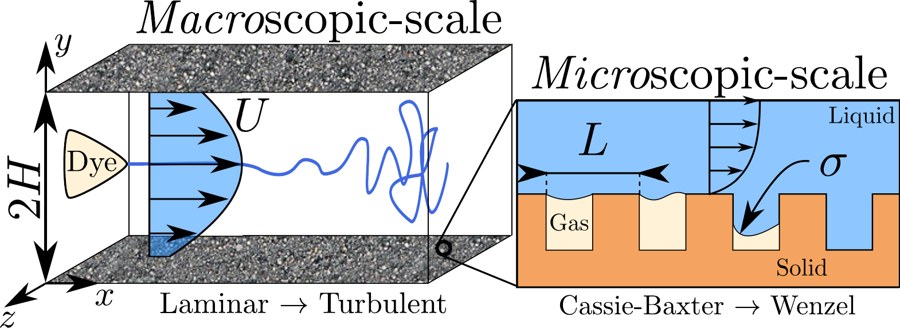
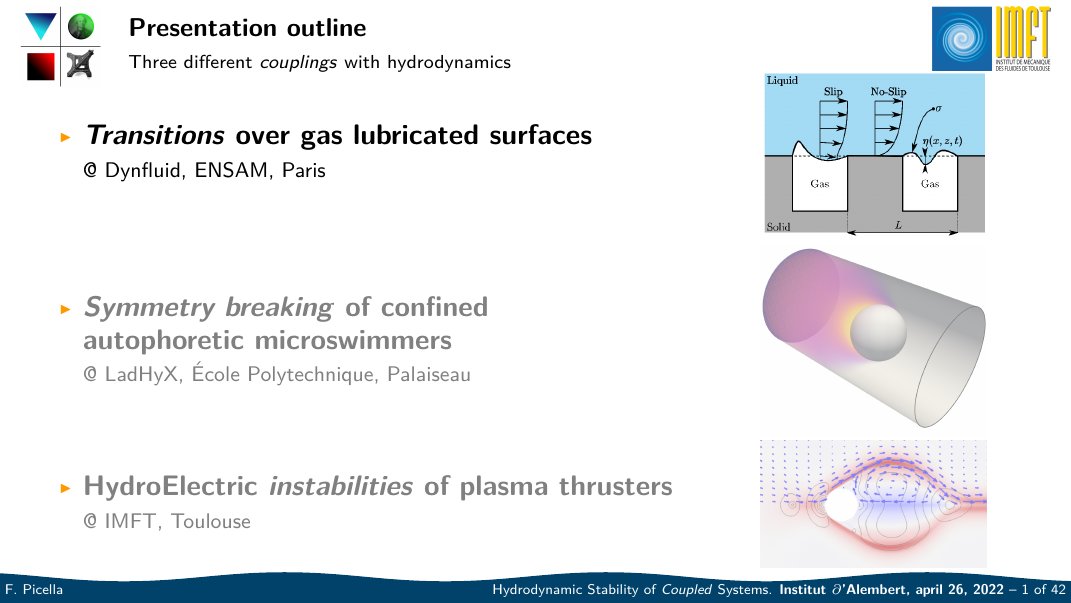
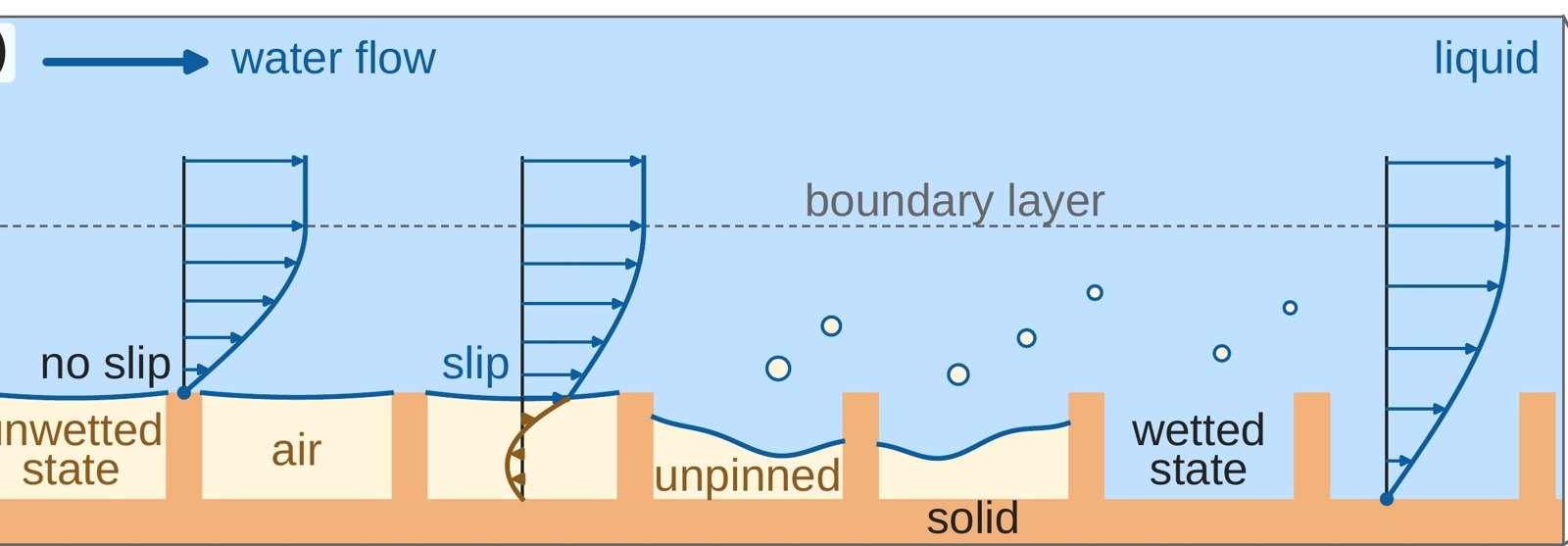
Superhydrophobic surfaces trap a thin layer of air, the plastron, between the solid and the water. The flow slips over the gas pockets, friction drops, and the idea of an air-lubricated ship hull is not far away. Most models freeze the air–water interface in place; in reality the trapped air responds to the flow — it deforms, it can be dragged out of its cavities — and the flow responds back.

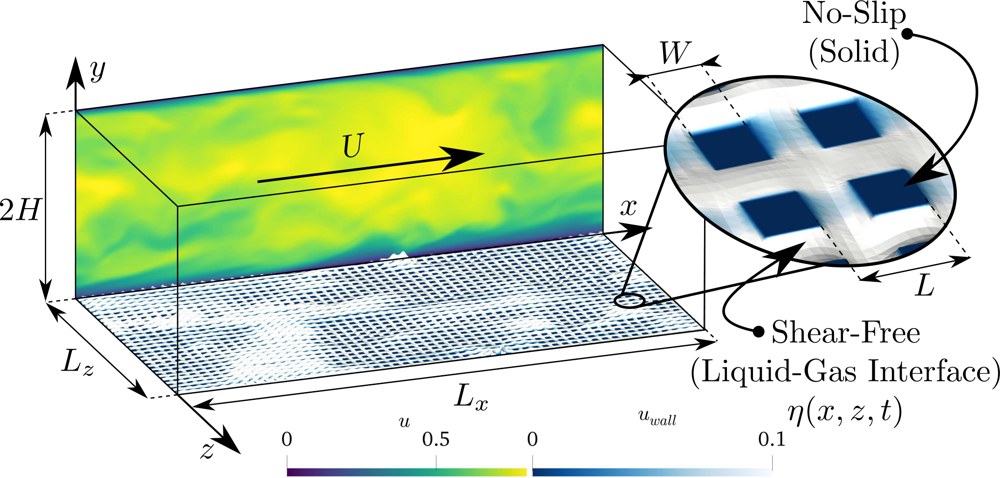
TARAS builds a two-way wall model for this coupling, from the microscopic gas pocket (deflection η, surface tension σ) to the laminar–turbulent transition of the whole channel, to predict when drag reduction survives and when it is lost.

Internship open for 2027 — see Students.

TARAS project logo: Taras surfing a wave on a Salvinia leaf whose hairs hold a layer of air
Taras rides the wave on a Salvinia leaf — the fern that keeps a layer of air on its hairs under water.
Zoom on the coated hull: water flows over a textured wall; where the texture holds air the velocity profile slips, where the interface unpins bubbles leave and the texture wets, and the wall is back to no slip
Zoom on the hull: water slips over the trapped air and friction drops; if the flow unpins the interface, the texture wets and the gain is lost.
A container ship whose hull is coated with an artificial Salvinia and rides on a layer of air
A hull coated like the fern rides on air: hull ≈ 100 m, texture 10–100 µm.

Chlamy — bioconvection and oxygen depletion in micro-algae suspensions

with Hélène de Maleprade (∂'Alembert) · bio-active fluids

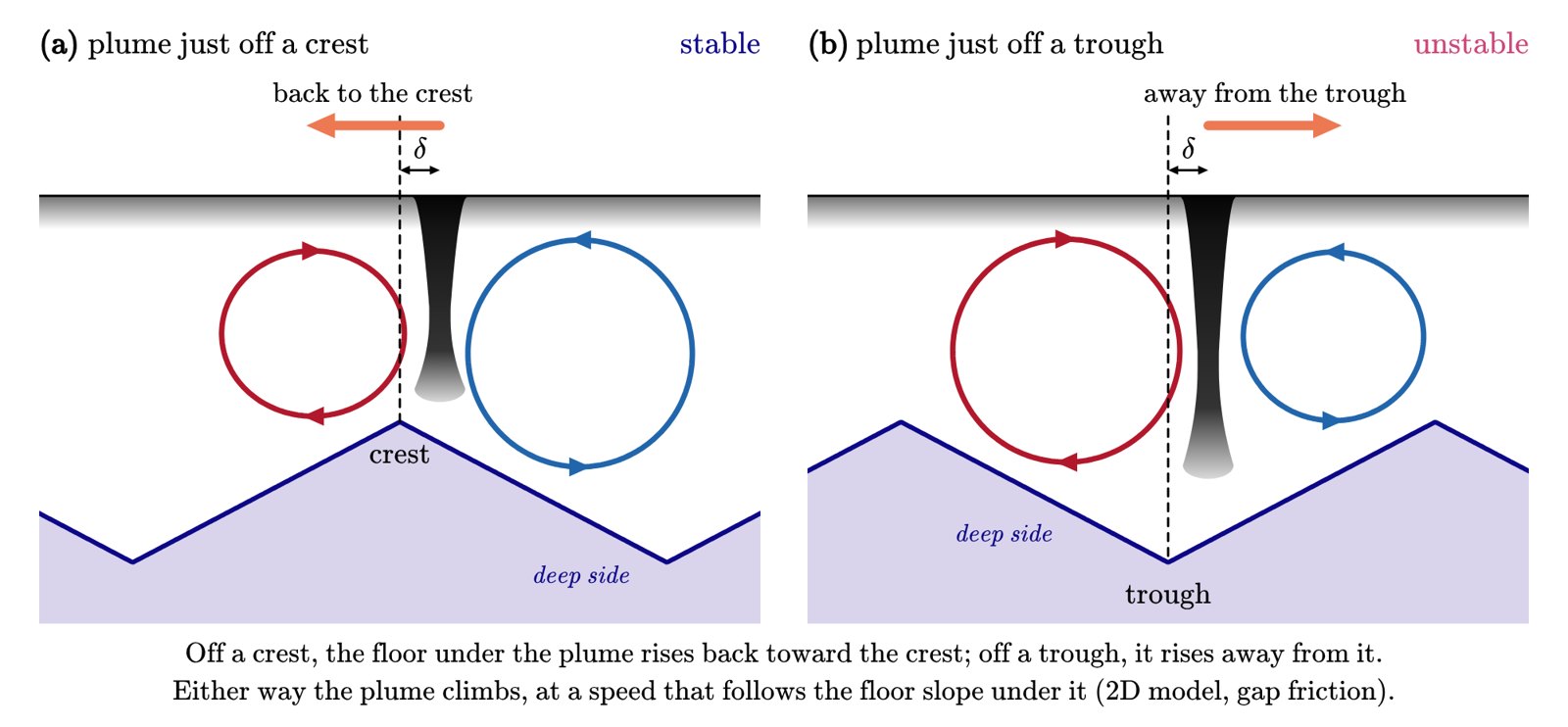
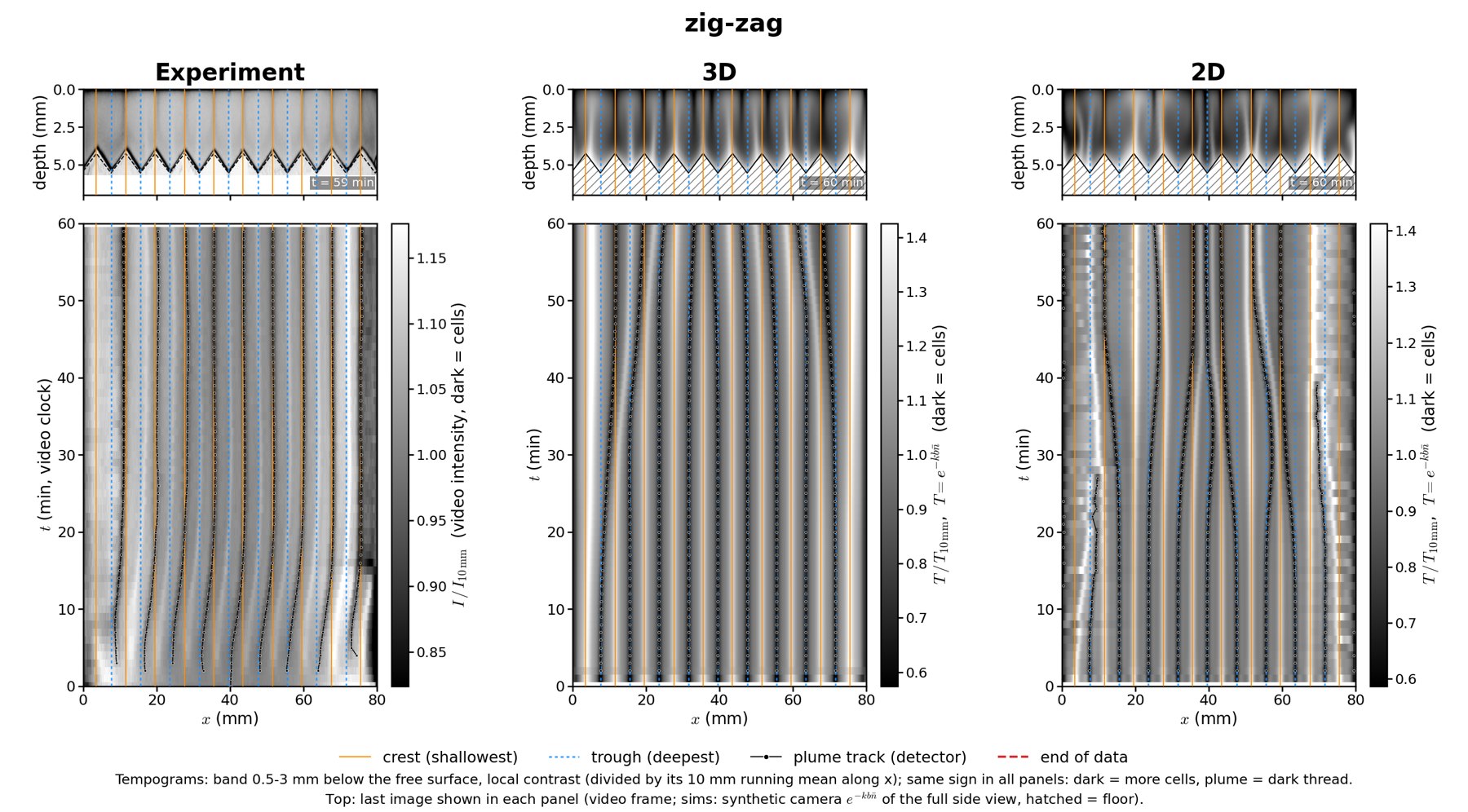
Chlamydomonas are swimming micro-algae, slightly denser than water, that swim upwards. Gathered at the top, the suspension becomes top-heavy and overturns into plumes and rolls: bioconvection. In experiments at ∂'Alembert, Hélène changes the environment — the light, the bathymetry of the cell — and the plumes answer: with a zigzag bottom they form under the crests rather than in the troughs.

On my side I write continuum models of the suspension and simulate them in 3D. Without noise the model lingers for a very long time before organising; with noise it falls at once into the state seen in experiments, which points to an instability that we now analyse with the tools of hydrodynamic stability. Next: coupling the cells' own oxygen consumption to the flow — what happens when the algae make their water anoxic.

Internship open for 2027 — see Students.
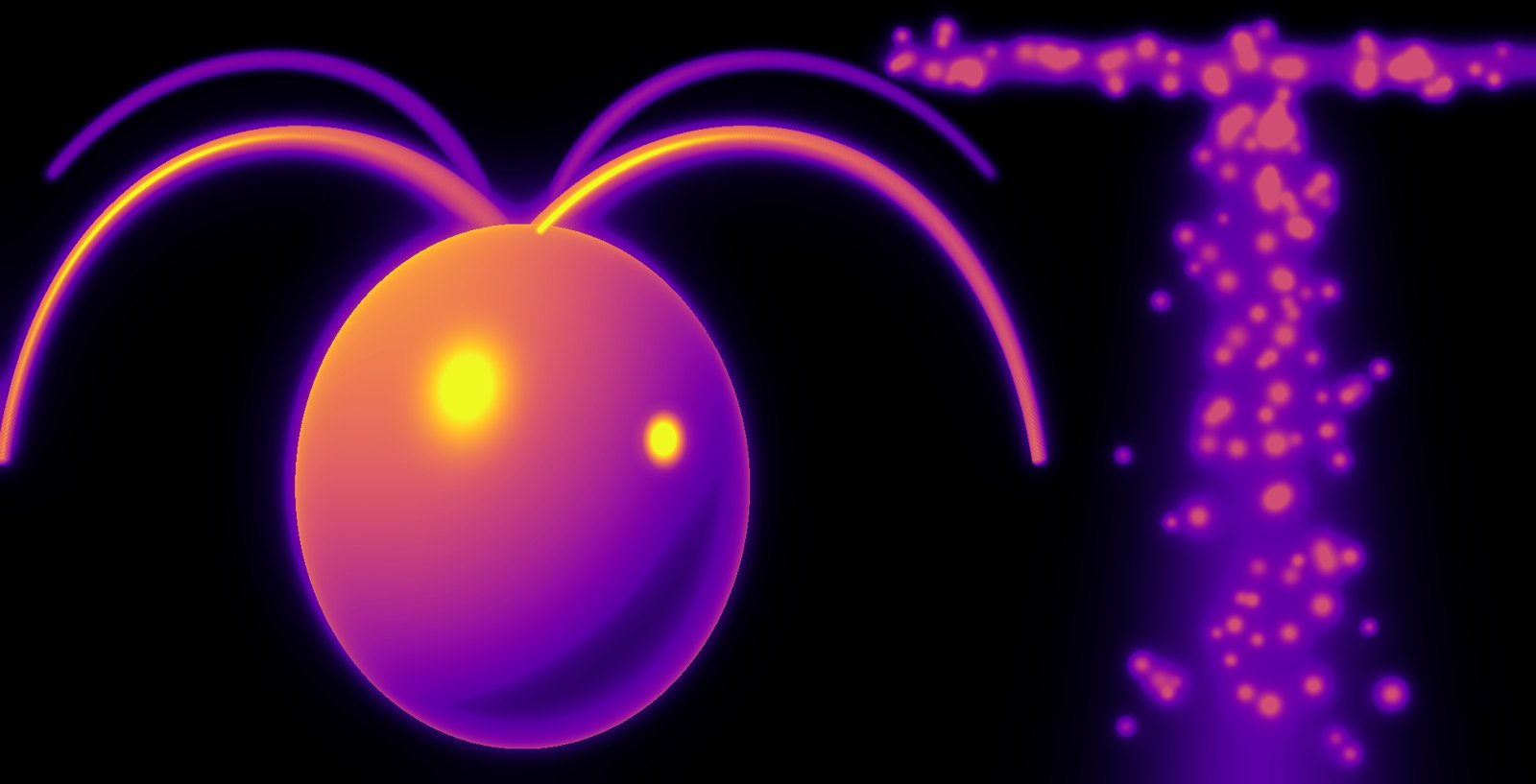
A single Chlamydomonas cell beating its two flagella; to its right a swarm of cells crowds under the surface and sinks as a plume
One cell (≈ 10 µm, swims up at ≈ 100 µm/s) — and the plume a crowd of them builds, a hundred times bigger.
Cartoon: a plume just off a crest is pushed back to the crest (stable); a plume just off a trough is pushed away from it (unstable)
Why plumes lock on crests: nudged off a crest, a plume climbs back; nudged off a trough, it climbs away.
Experiment versus model on a zig-zag floor: side views and space–time diagrams over 60 minutes for the experiment, the 3D simulation and the 2D simulation; plumes line up with the crests
Experiment vs model on the zig-zag floor (JMC 2026): side view at 60 min and space–time diagram of the plumes for the experiment (left), the 3D simulation (centre) and the 2D simulation (right). Orange lines mark the crests, dotted blue the troughs — the plumes end up on the crests in all three. Video version coming.

Research top

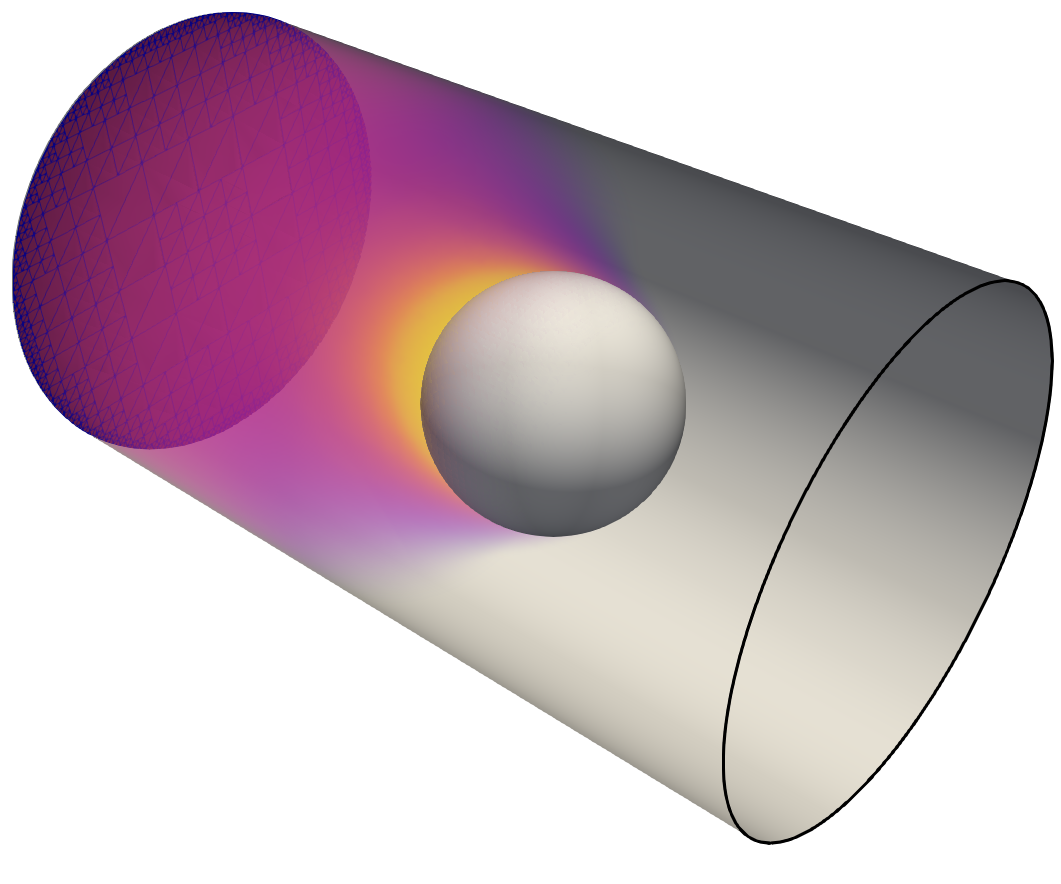
An isotropic active particle in a tube: confinement alone breaks the symmetry and the particle swims (Pe = 30).

Confined active colloids & phoretic swimmers

An isotropic active particle cannot swim in an unbounded fluid; confinement breaks the symmetry and selects swimming modes. I study which secondary bifurcations follow — steady, oscillatory, non-axisymmetric "spiralling" — with linear stability analysis and direct simulations. With S. Michelin (LadHyX, École Polytechnique).

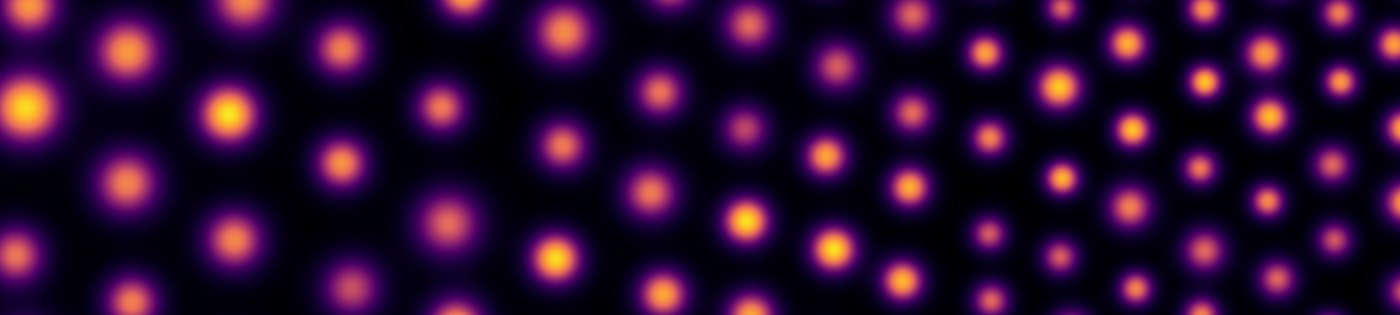
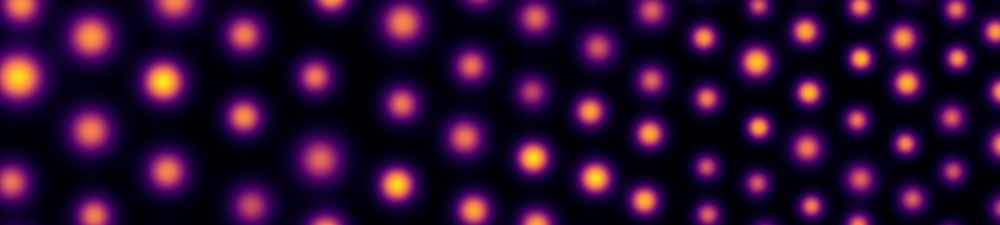
Top view of a bioconvection pattern of sinking plumes
Bioconvection pattern seen from above: each spot is a sinking plume of cells.

Bio-active fluids & bioconvection

Suspensions of swimming micro-organisms organise into convective rolls and plumes. I compare continuum models of these bio-active fluids, including the role of noise, with experiments. See the Chlamy project.

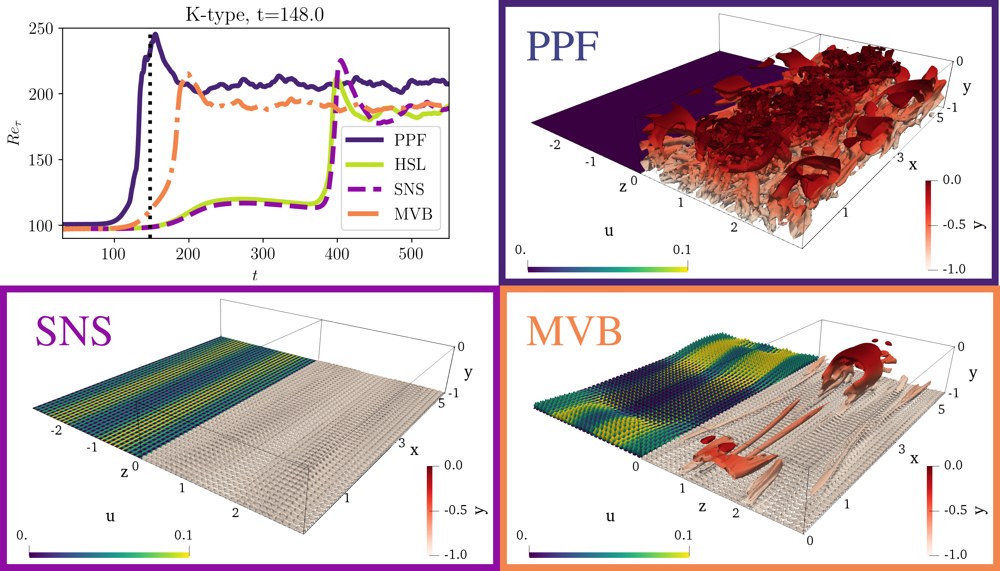
Four routes to turbulence in a channel with slippery walls — K-type, PPF, SNS and MVB scenarios, side by side.

Transition over biomimetic surfaces

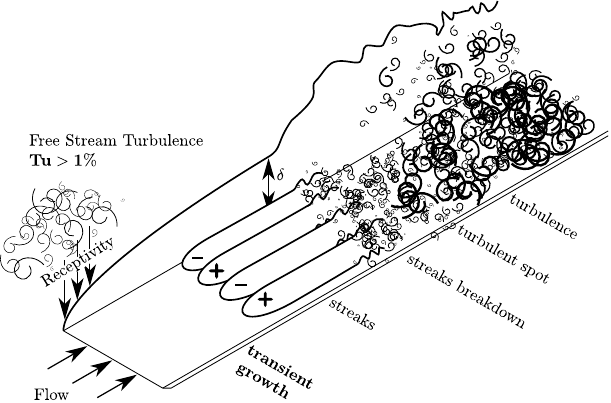
Lotus-like superhydrophobic walls, baromorphs and other slippery or compliant interfaces change how a laminar flow becomes turbulent. Receptivity, nonlinear optimal perturbations, and the question of how the surface should be modelled. See the TARAS project.

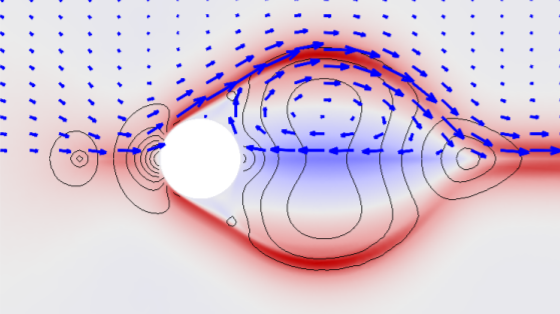
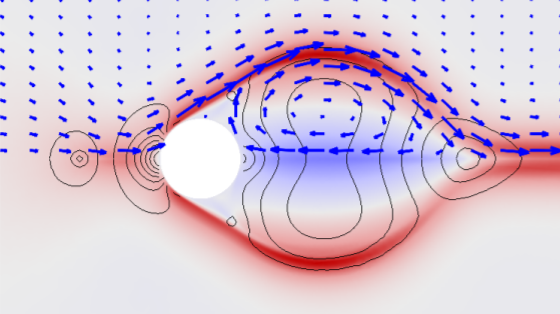
Ionic wind around a corona-discharge electrode
Ionic wind around a corona-discharge electrode (velocity and streamlines).

Stability of coupled flows

Global stability and bifurcation sequences in three-dimensional open cavities, flows coupled with electric fields (corona discharges, electro-hydrodynamics), and fluid–structure interaction with moving boundaries.

Publications top

Peer-reviewed articles, newest first. Full list on Google Scholar, open-access versions on HAL, ORCID 0000-0003-0630-1528.

Roll formation in a bio-active fluid

How a suspension of swimming micro-organisms self-organises into convective rolls, modelled as a bio-active fluid.

Givaudan M., Picella F., de Maleprade H., Comptes Rendus. Physique (2026). doi

Talks & media top

Seminars, interviews, outreach, and a few pictures from the road.

Teaching top

Sorbonne Université, Faculté des Sciences et Ingénierie — all my teaching is concentrated in the first semester.

Students top

I regularly supervise M1/M2 internships (February to September) on numerical modelling of active and bio-active fluids, instabilities and transition. If you want to join, send me a CV and a few lines about what you have done — and what you would like to do.

Internship poster: Out of breath — bioconvection and oxygen depletion
Internship 2027 — Chlamy: bioconvection and oxygen depletion in micro-algae suspensions (numerical modelling, M1/M2). poster
Internship poster: Surfing on air — TARAS
Internship 2027 — TARAS: trapped air responding to the flow on anti-drag surfaces (numerical modelling, M1/M2). poster

Former students top

Get in touch! top

francesco.picella [at] sorbonne-universite.fr
+33 (0)1 44 27 54 68

Institut Jean Le Rond ∂'Alembert
Sorbonne Université, Campus Pierre et Marie Curie
Tour 55-65, 5e étage, bureau 520
Boîte courrier 162, 4 place Jussieu
75252 Paris Cedex 05, France